GUARDIANS
Digital solutions for small- and medium sized farms

The new EU project GUARDIANS aims to strengthen the competitiveness of small and medium-sized farms using relevant digital technologies. The project will test innovative digital technologies through pilot projects with small and medium-sized farms in Sweden, Italy, Spain and the Czech Republic. The test farms have various productions from feed and meat to honey and fruit.
Start
01. Mar 2023
End
28. Feb 2027
Funded by
Horizon Europe
Project Manager(s):
Other Participants:
Watch film about GUARDIANS
GUARDIANS empowers small- and medium-sized farms through smart solutions, bridging the technological gap with larger food producers.
Watch a presentation film about the EU-project.
Background
A sustainable food system relies on empowering small- and medium-sized farmers—often the key stewards of rural landscapes. The GUARDIANS initiative examines the structural and operational challenges these farmers encounter, particularly those that limit their competitiveness against large-scale producers.
To address these barriers, GUARDIANS promotes digital and innovative solutions that reduce the technological gap, enabling small farms to adopt more sustainable practices—economically, environmentally, and socially. These tools aim to enhance farm productivity and resilience, ensuring the long-term viability of small-scale agriculture while supporting shared sustainability goals.
Goal
The primary objective of the EU project GUARDIANS is to empower small- and medium-sized farms through innovative solutions. A multi-actor co-creation methodological framework supported by farmer engagement and an acceptance package will leverage the uptake rates of innovative digital technologies by farmers.
The project develops a set of nine digital innovative solutions clustered in three categories:
- SMART – smart farming for labour support,
- CAP – solving issues related to Common Agricultural Policy,
- ENV – environmental valorisation.
These solutions will be tested in four testbeds and piloted on at least 22 small- and medium-sized farms (encompassing different types of crops, grassland, and livestock) in Spain, Italy, Sweden, and Czechia, ultimately reaching a total of 95 farmers through the rollout and replication phase.
Specific objectives
- Tailored digital solutions: Develop and test a diverse set of digital technologies adapted to the needs of small- and medium-sized farms across Europe, supporting arable, woody, and livestock systems.
- Co-creation for adoption: Implement a multi-actor co-creation framework to enhance farmers’ digital maturity and ensure the uptake of user-friendly technologies.
- Sustainable business models: Define pathways toward resilient and agroecological farming models, supported by cooperative-based governance structures and smart technologies.
- One-Stop Innovation Hubs: Establish local one-stop shops within farming cooperatives to provide integrated access to technologies, business models, and financial tools.
- Environmental and social valorisation: Promote the recognition of sustainable farming practices through certification (e.g., blockchain), highlighting improvements in soil health, input reduction, and climate impact.
- Cascade funding mechanism: Deploy a cascading grants scheme to engage new SMEs, start-ups, and farmers in testing and scaling digital innovations within the GUARDIANS framework
What we do
We lead the task on defining the co-creation methodological framework for supporting technology providers in customizing innovative solutions to meet the needs of small- and medium-sized farms. We also develop the farmer engagement and technology acceptance package that will be used in the following stages of the project – from testbeds to pilots to replication. After each phase where farmers experience technologies at different scales, an acceptance survey is conducted to evaluate the extent to which farmers are willing to adopt the technology in the future and to collect information and feedback about potential improvements. In this way, Nofima plays a relevant role in connecting farmers with cooperatives and technology developers to facilitate technology uptake.
Nofima will monitor and measure the practical application of the technologies developed in the project. The assessment method draws upon the Unified Theory of Acceptance and Use of Technology (UTAUT), a model that explains why people accept and use new technology. It is based on four key constructs: performance expectancy (usefulness), effort expectancy (ease of use), social influence, and facilitating conditions (support). These factors predict an individual’s behavioral intention and actual use of a technology.
Facts about the project
GUARDIANS is a four-year project with 22 partners from nine European countries.
The project is funded with EUR 5 million through Horizon Europe and is led by CTIC Technology in Spain.
Do you want to know more about the project: https://guardians-project.eu/
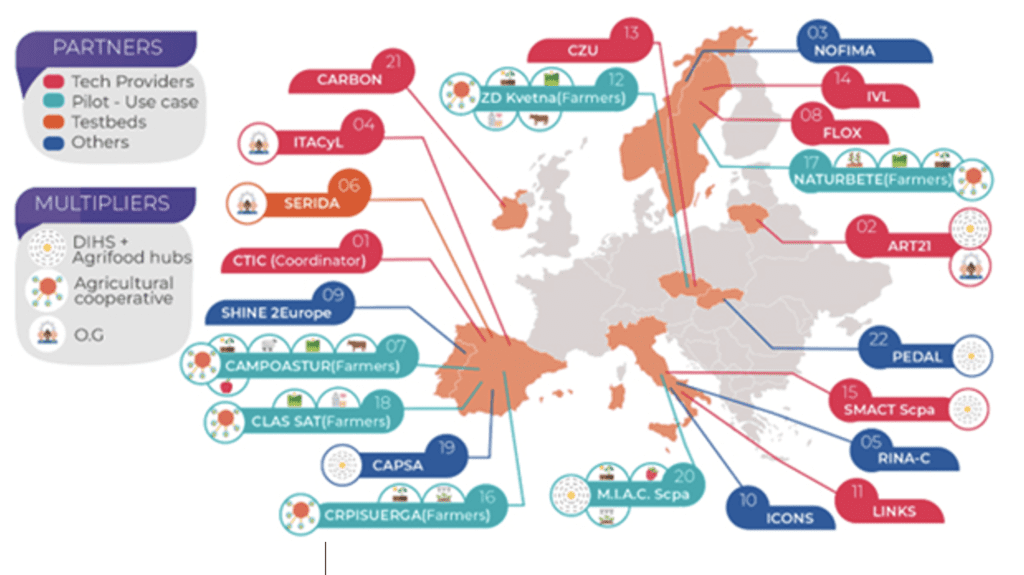
Partners
Publications