
One bacterial threshold does not suit all fresh chicken
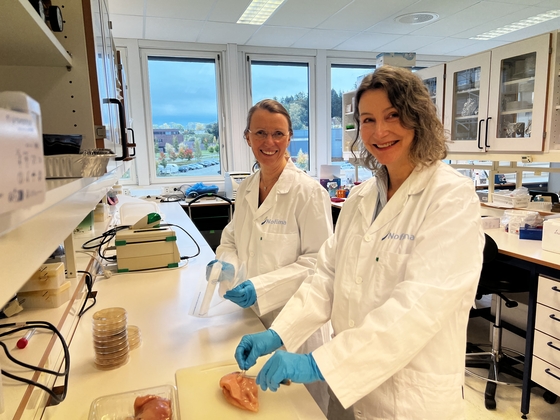
Fresh chicken may be rejected by consumers before bacterial levels reach the thresholds commonly used today. A Nofima-led study shows that producers should consider both bacterial composition and odour when setting use-by dates.
Key findings
- Chicken fillets from Norway, Portugal and Hungary developed different bacterial communities during storage.
- Consumers rejected the products at different bacterial levels. A single threshold is therefore not appropriate for all fresh chicken.
- The scientists recommend that producers set use-by dates on the basis of bacterial measurements, realistic temperature conditions and consumer acceptance.
Clear thresholds exist for pathogenic bacteria. However, for bacteria that cause off-odours and quality deterioration, the industry often relies on a fixed limit for the total bacterial count.
“One bacterial threshold does not suit all fresh chicken. Producers should also link bacterial measurements to the point at which consumers begin to reject the product,” says Senior Scientist Solveig Langsrud, who led the study.
Different bacteria prompt different responses
The scientists examined chicken fillets from producers in Hungary, Norway and Portugal. They found distinct bacterial communities in products from the three countries.
Lactic acid bacteria dominated the Norwegian fillets, Photobacterium the Hungarian chicken and in the Portuguese fillets, Brochothrix and bacteria from the Yersiniaceae family were dominant. These bacteria can contribute to off-odours but do not make people ill.
Shelf life and packaging methods varied between the chicken fillets from the three countries. In Norway, chicken is packed in a modified atmosphere containing carbon dioxide and nitrogen, with a 20-day shelf life. In Portugal, chicken is packed with oxygen, carbon dioxide and nitrogen, with a declared shelf life of seven days. In Hungary, the chicken is vacuum-packed and has a shelf life of ten days.
In total, 365 consumers smelled samples stored at 4 °C and 8 °C and answered one specific question: would they cook and eat the fillet, or discard it? Consumers rejected the Hungarian fillets at bacterial levels that were lower than in the Norwegian and Portuguese fillets.
“We believe the difference is linked to the bacteria that developed in the packages. Different bacteria can produce different odours. As a result, consumers may perceive two products with broadly similar total bacterial counts very differently,” Langsrud explains.
Higher temperatures reduce quality
The scientists stored some packs at 4 °C throughout the trial. Other packs were initially stored at 4 °C and later moved to 8 °C, simulating temperature deviations that may occur in retail, during transport or in consumers’ homes.
They measured bacterial growth and identified the bacteria present, using both conventional culture-based laboratory methods and DNA analysis. DNA analysis is important because conventional methods may fail to detect bacteria that do not grow well on standard culture media.
Bacteria grew faster when the temperature increased from 4 °C to 8 °C. The bacterial communities also changed. In the Norwegian and Portuguese products, the higher temperature led more consumers to reject the chicken.
Check the full journey from processing line to home
The findings show that shelf-life testing should consider the entire journey from the processing line to the consumer’s refrigerator. Testing should therefore include both standard chilled conditions and temperature variations that may occur along the supply chain.
“Producers should test their products both at normal refrigeration temperatures and at temperatures that can occur in everyday life. To use a fixed limit value, the bacterial composition must remain the same over time. We examined this in a parallel study and found that the bacterial flora is stable for each product. This means each company can use the same limit value over time,” explains Birgitte Moen, Senior Scientist at Nofima, who led the parallel study.
Scientific method
- The study combined laboratory testing and consumer assessment to investigate the relationship between microbiological development and sensory acceptance of industrially packed chicken breast fillets.
- The material consisted of fresh chicken breast fillets from producers in Hungary, Norway and Portugal. Samples were stored at 4 °C, with temperature deviations at 8 °C, for up to 27 days.
- Bacterial levels were measured using viable bacterial counts, while bacterial communities were mapped using 16S rRNA sequencing and MALDI-TOF, a rapid method for bacterial identification.
- A total of 365 consumers across the three countries smelled 11 chicken samples each and assessed whether they regarded the meat as acceptable to eat.
- The scientists analysed the data using survival analysis, a statistical approach for modelling the probability of rejection, with storage time and bacterial counts as explanatory variables.
Research facts
The research was carried out through the MICROORC and MicroPack projects. Funding was provided by the EU Horizon Europe programme (No. 101136248, MICROORC), the Norwegian Research Levy on Agricultural Products and Portugal’s Fundação para a Ciência e Tecnologia.
The studies involved Nofima in Norway, the University of Veterinary Medicine Budapest in Hungary and Universidade Católica Portuguesa in Portugal.