
PhD on using fish in food products
Side streams from the fish industry – in other words, the parts of the fish that don’t end up as fillets – could make plant-based food products better. A new PhD thesis shows how this potential can be harnessed using modern processing technology.
Main findings
- Side streams from the fish industry, such as heads, backbones and skin, can be used to make plant-based food products more nutritious, thereby increasing the value of raw material that today largely goes to animal feed, biofuel and fertiliser.
- The PhD thesis shows that fish-based ingredients can be combined with plant proteins and processed using extrusion to give products a better structure, texture and mouthfeel.
- The research has identified which mixing ratios and processing conditions work best, making it easier for industry to adopt such ingredients. One example is that salmon hydrolysate can partly replace water while also increasing the nutritional content.
- The findings could contribute to the development of new food products, such as burgers and nuggets, and represent an important step towards better use of marine side streams in food production.
Once the fillet has been removed from a fish, what remains, including the head, backbone and skin, is not currently used to its full potential. This side stream holds potentially significant value, both nutritionally and economically. Today it is used mainly for animal feed, biofuel and fertiliser, but a greater share could be put to use in food production. At the same time, many people want to cut down on their meat consumption, but plant-based products often lack certain important nutrients. By enriching plant-based products with ingredients derived from fish-industry side streams, it is possible to develop food products with a more favourable nutrient profile.
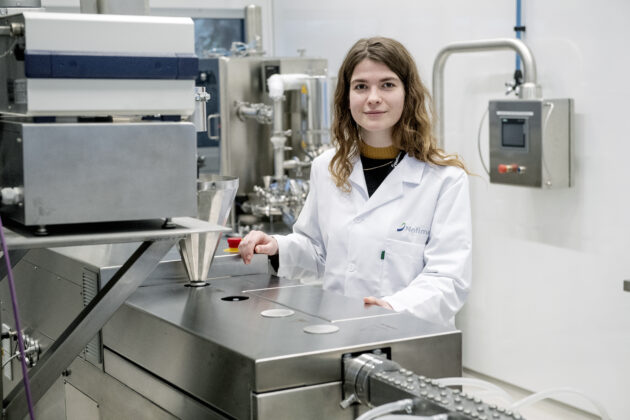
In her PhD work, Liv Helene Sickel shows how different fish-based ingredients affect the quality of plant-based food products, with a particular focus on texture. She studied how extrusion technology can be used to create an improved structure in mixtures of pea protein, wheat gluten and fish raw material in varying proportions. The research, carried out in Norway at Nofima and the University of Bergen, shows how much fish it makes sense to add, based on how the different ingredients affect the texture. Sickel has also identified processing conditions that make it easier for industry to successfully adopt such ingredients. The result is a better mouthfeel and texture experience when used in food.
Why focus on texture?
While a fish fillet has a clear fibrous structure, where you can both see and feel the direction of the muscle fibres, raw material from the head, backbone and skin is often ground up before being used in food. Products based on such raw material therefore tend to feel more uniform, rather like the texture of a fishcake. In the same way, many plant-based products lack a clear structure, because they are typically ground into a smooth mass before being shaped and processed into finished products. This can make the eating experience less varied and interesting.
“If you cut a finely ground fishcake into cubes, they will look the same from every side. With extrusion technology and the functional properties of different protein-rich ingredients, we can recreate a sense of direction and thereby a more varied and exciting mouthfeel”, says Sickel.
Extrusion is a technology widely used in the food industry. The need to create a fibrous structure in meat substitutes and vegetarian products is equally relevant for products containing added fish raw material.
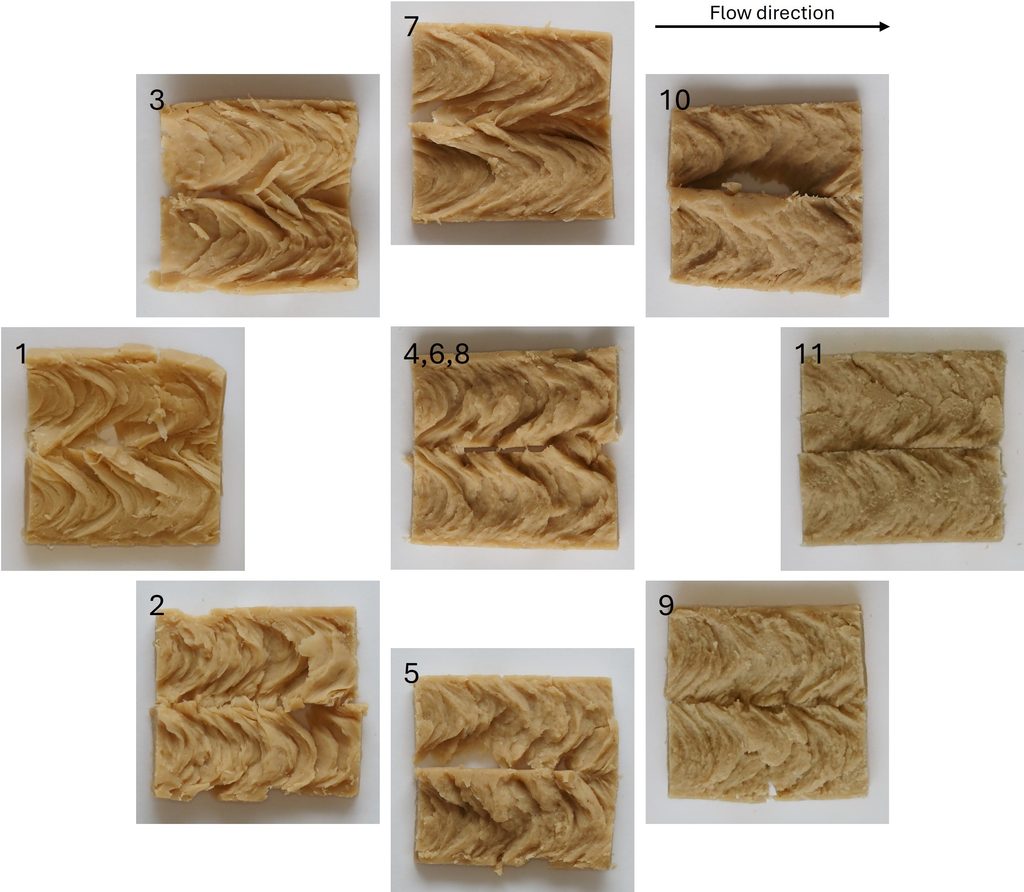
Sickel has studied three different ingredients derived from fish-industry raw material: cod powder, wet-ground cod backbones, and a hydrolysate produced from salmon trimmings. When these ingredients are included in various product formulations and processed using extrusion, the result is what she calls “intermediate products”.
If the knowledge from this PhD is applied to commercial production, protein-rich, fibrous intermediate products enriched with ingredients from side streams could be further processed into frozen foods such as burgers and nuggets.
How the raw material behaves
Sickel has also studied the mechanisms behind the various intermediate products, and how they “behave” during processing.
“It can be compared to the adjustments we make when baking. Wheat flour and rye flour, for example, behave differently in a bread dough. If you swap one for the other, the water content, kneading time, baking time and other conditions need to be adjusted. It’s the same with the ingredients we’ve studied here”, explains Sickel.
Through her PhD work, she has defined how processing conditions should be adapted to different mixing ratios of plant proteins and cod- and salmon-based ingredients. One example is that a salmon hydrolysate can partly replace water while increasing the nutritional content, without affecting the processing properties.
Creating ultra-processed ingredients
What Sickel is doing is ultra-processing the fish raw material. Why did she want to research this?
“Ideologically, my choice comes down to resource utilisation. By creating opportunities to use more protein from fish we have already harvested, we could give the fishing industry an incentive to take better care of the raw material and use it in food. These side streams consist of valuable marine nutrients that can bring positive health benefits”, says Sickel.
She points out that not all ultra-processed products are unhealthy, but that most foods considered unhealthy are ultra-processed.
“I also enjoy cooking myself, and I find both the process and the industry perspective exciting”, says the PhD candidate with a smile.
The conclusion of the PhD work is that ingredients from side streams can be used as an ingredient in the production of fibrous intermediate products through extrusion. This is a promising step towards greater use of marine side streams within existing processing chains and familiar product segments.
The conclusion of the PhD work is that ingredients from side streams can be used as an ingredient in the production of fibrous intermediate products through extrusion. This is a promising step towards greater use of marine side streams within existing processing chains and familiar product segments.
About the PhD candidate
Liv Helene Sickel is 29 years old. She holds a master’s degree in physical chemistry from the Department of Chemistry at the University of Bergen. She is currently completing her PhD at Nofima and UiB. Her supervisors have been Tor Andreas Samuelsen and Åge Oterhals from Nofima, together with Tore Skodvin from UiB and Atze van der Goot from Wageningen University. Sickel will defend her thesis at UiB on 11 September 2026.
Facts about the research
Publication
The work is part of a PhD thesis, and the publications it comprises will be added here on an ongoing basis: