
Smart sensors provide better control and less waste
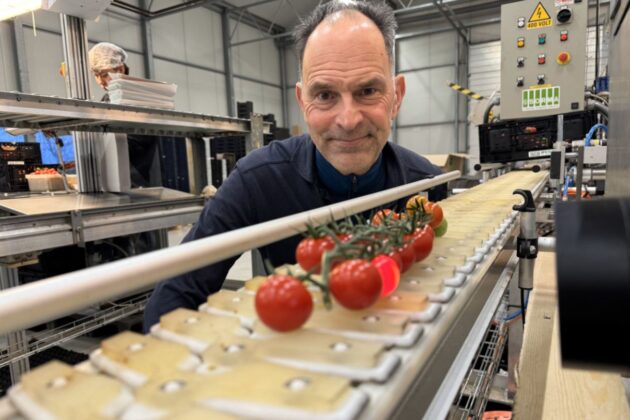
When quality can be measured continuously, food manufacturers can control their processes more tightly, make better use of raw materials and reduce waste. At DigiFoods, researchers are developing smart sensors that can measure critical quality parameters directly in the process lines; from fish and meat to vegetables, dairy products and in bioprocessing.
DigiFoods is a centre for research-based innovation (SFI) led by Nofima, with SINTEF and NMBU as main partners and a large number of food and technology companies as active industry partners.
From research centre to factory floor
“We are now well over halfway through the centre period, and much of the research has moved from the laboratory to full-scale trials in the industry,” says Jens Petter would, Senior Scientist at Nofima and head of DigiFoods.
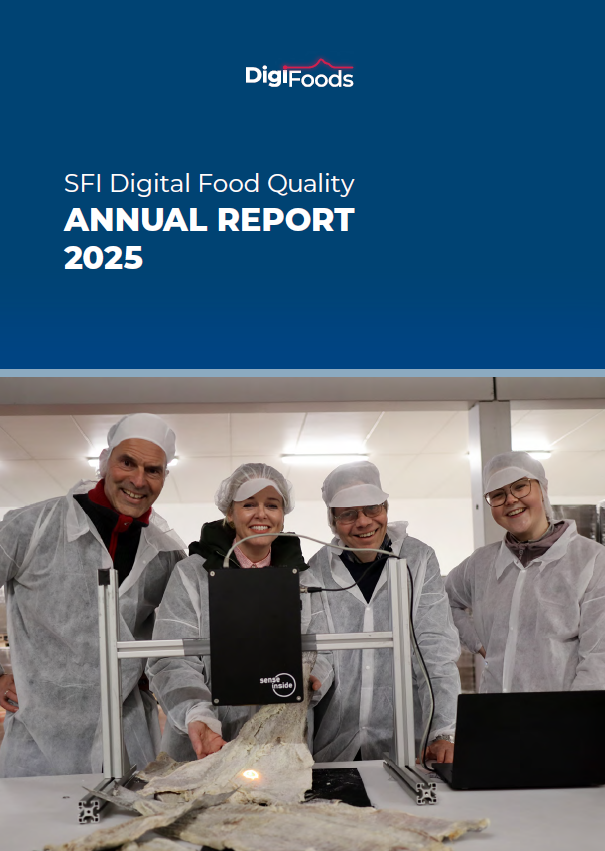
A key innovation in DigiFoods is the sensor SenseInside. It has been developed by scientists at Nofima and SINTEF, and uses near-infrared (NIR) technology to measure quality without touching the product and without stopping production.
The sensor has been tested in several areas:
- Water in salted fish and clipfish
- Core temperature in fish cakes
- Meat content of king crab
- Sweetness in strawberries and tomatoes
- Dry matter in potatoes
“For the clipfish industry, the sensor provides far more frequent and precise measurements of water than manual spot checks. This makes it easier to control drying, avoid defective products and take better care of the raw material,” Jens Petter would points out.
More stable dairy quality with sensors and artificial intelligence
More stable dairy quality with sensors and artificial intelligence
In the dairy sector, Nofima and Intelecy are collaborating with TINE to achieve more stable quality of cheese and whey-based protein powder. Here, sensors and artificial intelligence are an important part of the solution.
At TINE Jæren, research has previously resulted in more even dry matter in cheese through better temperature control. Now the focus is on drying protein powder, where the water content affects both quality and energy consumption. Analysis of process data shows which conditions give rise to deviations, and provides a basis for early warning and adjustment.
“It’s not just about more data, but about data that can actually be used by the operators in everyday life,” would says.
New tools for utilising residual raw materials
The experts at DigiFoods have also developed new measurement methods that can help the industry make better use of residual raw materials. They work with residual raw materials from chicken and salmon, in collaboration with Norilia and Biomega, respectively.
For protein hydrolysates, NMBU and Nofima have further developed the use of infrared (FTIR) spectroscopy. The method uses dry films instead of liquid samples and provides detailed information about both peptide size and collagen content. The technology makes it possible to follow the process more closely, adjust earlier and document quality in a better way.
In another experiment, Nofima and Biomega have integrated sensors directly into process pipes where the salmon raw material flows. Among other things, the sensors measure fat and water content continuously, so that operators will be able to adjust the process in real time and utilise the residual raw material more precisely.
Data that turns into better decisions
The researchers have also developed new methods for studying cause-and-effect in process data. The goal is to distinguish between factors that just come with it, and factors that can actually be controlled to provide better products and less waste.
When such methods are combined with sensors such as SenseInside and NIR measurements at TINE, the industry opens up completely new opportunities. Manufacturers can control processes based on up-to-date knowledge of raw materials and products, rather than few and late laboratory measurements.
“We see that the best results come when sensors, process understanding and data analysis are developed together with the industry,” would says.
The next steps in DigiFoods
In the future work, the centre will continue its work to:
- develop and test new sensor concepts in line
- build robust models that can withstand variations in raw materials and operations
- translate advanced measurements into simple tools for operators
- Connect sensor data to both process quality and consumer experience
The goal is for Norwegian food companies to be able to make better choices, at the right time, based on ongoing quality data. This results in more efficient production, more stable quality and less waste throughout the value chain.
Contact

Research facilities