
A sensor installed inside the pipe provides better answers about raw material quality
When fish trimmings flow through the pipes at Biomega, lightmonitors the stream. Two light based measurement methods look directly into the flow of ground residual raw materials and reveal what it contains.
Briefly summarised:
- Biomega and Nofima have developed a custom pipe section with NIR and Raman sensors that measure raw material quality directly in the process pipes
- The fibre‑optic probes provide continuous readings of, among other things, water and fat content
- This gives Biomega far better control of a highly variable stream of residual raw material
- Nofima’s researchers have developed and calibrated the measurement models through extensive laboratory trials, and have tested the solution at full scale together with Biomega.
The new measurement methods make it possible to monitor the quality of residual raw materials inside the process pipelines, giving Biomega better control of the fat and water content and enabling more consistent products from highly variable residual raw materials.
“Our aim is to develop a solution that gives better oversight of the quality of the incoming raw material. When we know the quality of the residual raw materials, we can adjust the process so that the final product is as similar as possible from batch to batch,” says postdoctoral scientist Tiril Lintvedt at Nofima and DigiFoods.
Specially designed pipe section enables inline measurements
At Biomega’s facility at Sotra, a straight pipe segment has been replaced with a specially designed section with two sensor probes mounted 50 centimetres apart. This distance was critical to ensure that light from the probes did not interfere with each other’s measurements. One probe is connected to a NIR instrument and the other to a Raman instrument, and both send light into the stream of coarsely ground fish trimmings.
“What is new is that we can measure raw material quality directly in the pipeline as the materialflows past,” says senior engineer Katinka Dankel at Nofima.
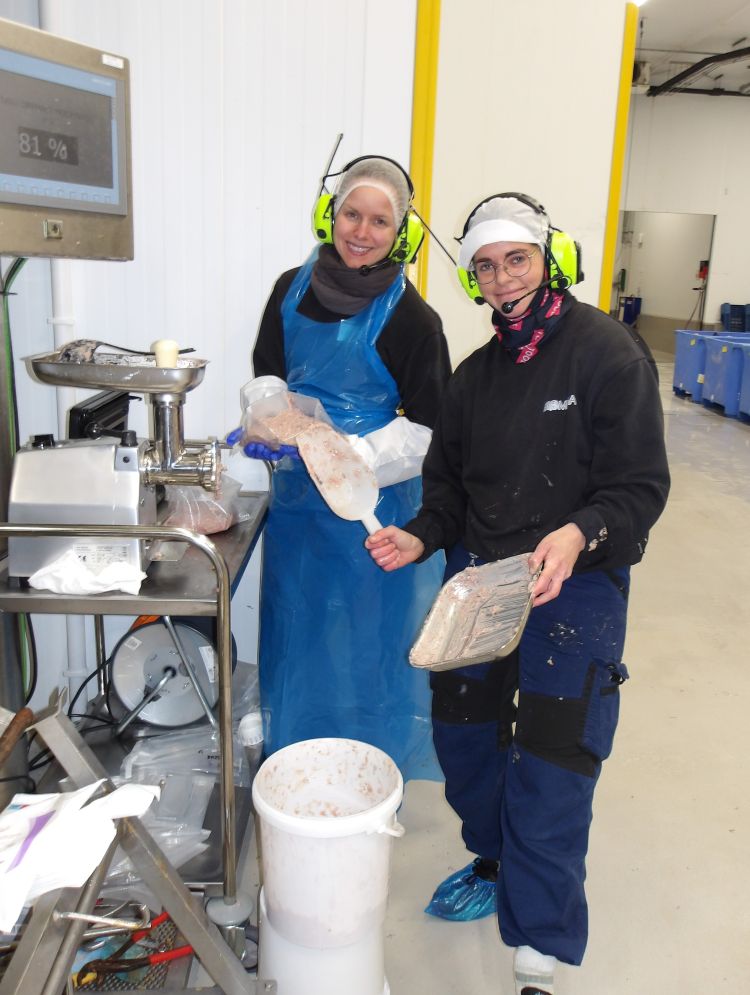
In earlier trials, NIR measurements were carried out at the grinder, which was impractical and difficult to keep clean. Now that the trimming mixture flows past the probes in a closed system, there is less mess and fewer disturbances.
“There was close collaboration between Biomega and Nofima throughout the process to identify the best solution. We had a good dialogue about what was important when installing the instruments in the pipe. Biomega drew the final design and ordered the new pipe section,” explains Tiril Lintvedt.
Once the special pipe section was installed, staff at Biomega and Nofima had to find the optimal location for the parts of the instruments that are not in direct contact with the product. In fiber‑optic systems like this, the probe is mounted in the pipe, while optical fibers guide the light to the rest of the instrument, where the signals are read. At Biomega, the detectors were placed ten meters from the probes, a distance that could be much longer without compromising measurement quality. The solution was a wall‑mounted instrument cabinet with ventilation that keeps the temperature stable and prevents moisture ingress.
“One of our goals is that the pipe measurements will help us adjust the process in real time and achieve more stable operation. Whether this alone will deliver a more consistent final product is still uncertain, but it may become possible over time. A major advantage is that we obtain more reliable yield figures, even when the composition of the raw materials changes, particularly the water content. This provides better insight into how the process responds to different conditions, for example over the course of the year,” says Biomega scientist Silje Steinsholm.
From laboratory trials to the processing line
Extensive preparatory work was required before measurements could start at Biomega. A key task was to develop calibrations – models that translate light signals into quantitative values for constituents such as fat and water.
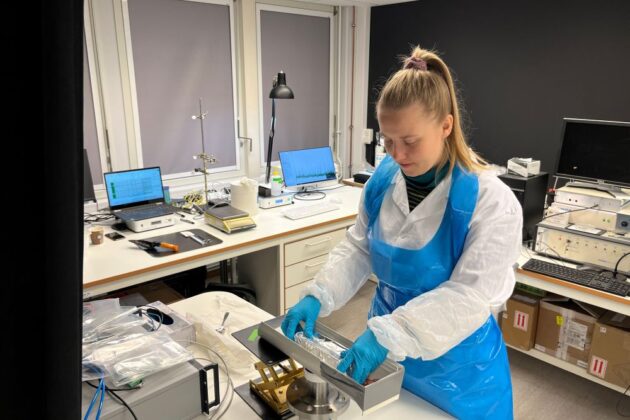
“We placed the probe in a half‑pipe channel, a pipe cut lengthwise, to simulate measurements inside the process pipes in the laboratory. We received frozen, ground fractions and clean bone from Biomega, which we blended into different residual raw material mixtures,” explains Lintvedt. “We slided the mixtures through the half‑pipe and measured them as the temperature increased from four to thirteen degrees. All spectra were included in the calibrations so that the models can recognize the variation occurring on the processing line.”
She adds that the samples were first analyzed with Raman and then with NIR, and that spectra at different temperatures were included in the models to capture the temperature variation that is typical at Biomega.
NIR and Raman offer different strengths
NIR (near‑infrared spectroscopy) and Raman spectroscopy are two spectroscopic techniques that both use light to analyze raw materials without destroying them.
NIR sends infrared light towards or through the raw material and measures how different wavelengths are absorbed, responding strongly to, among other things, water and fat. When the light hits the mixture in the pipe, some of it is reflected, and the pattern in the signal reflects the composition of the raw material. The method is rapid and well suited for continuous process monitoring.
Raman uses laser light to capture how molecules vibrate, and can provide detailed information about, for example, bones, proteins and fatty acid composition. The method delivers more detailed information than NIR, but it demands more advanced data processing and instrumentation.
“In this case, the highly variable material was challenging, but we have gained important knowledge for further development of Raman methods. Raman is little used in the food industry, so testing the technology on such a demanding raw material is an important step forward,” Lintvedt points out.
The impact for Biomega
Biomega sources fish trimmings from several slaughterhouses, and the composition varies from delivery to delivery. Some batches contain more skin, and therefore more fat, while others have more bone or muscle. Such variation can cause unstable processing conditions and unpredictable final product quality. In the control room, operators monitor the process around the clock, tracking pressure, temperatures and a wide range of other process parameters.
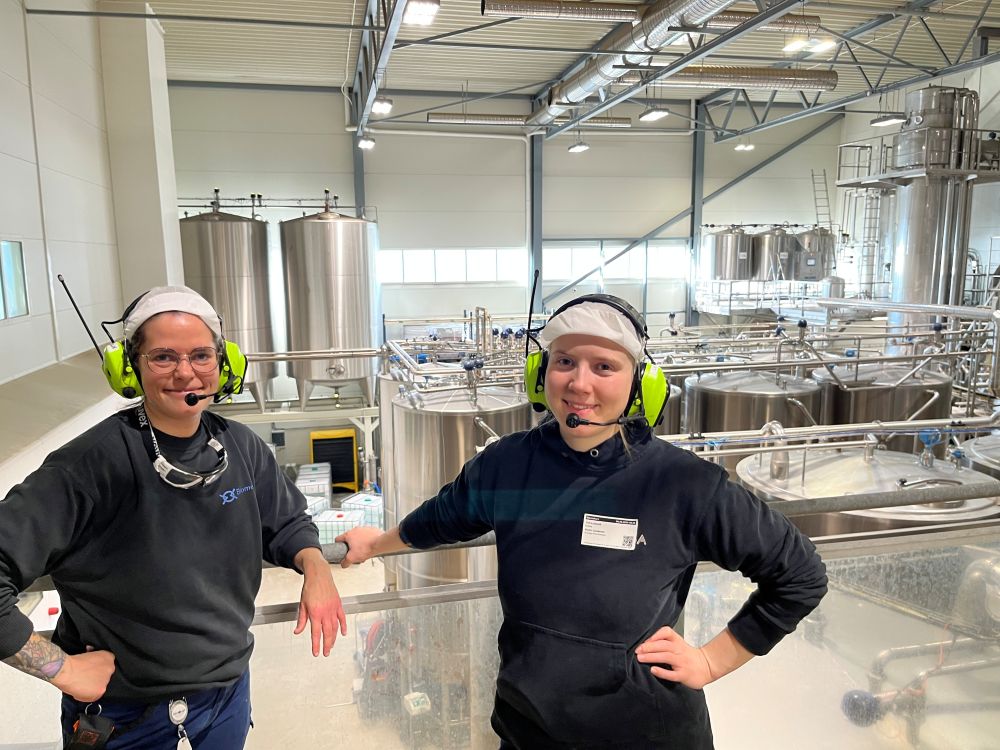
With the new NIR sensor inside the pipes, operators gain valuable real‑time data and can follow the raw material mixture continuously as it moves through the system. NIR measurements enable operators to anticipate practical challenges and to diagnose problems that have already occurred. If the fat content is too high, for instance, the mixture quickly becomes thick and clay‑like. The measurements also open up opportunities to optimize the process: if the residual raw materials contain a lot of water, less water can be added later, and operators can adjust key parameters to achieve the best possible product characteristics.
Over four days, specialists from Nofima and Biomega worked together to measure the composition of the mixtures flowing through the pipes, collecting more than 1.7 million NIR spectra.
“The analyses show that the NIR instrument gives us a clear picture of how the composition changes from minute to minute, so we can see what is happening inside the pipes as it happens and adjust in time to secure more stable product quality,” concludes Tiril Lintvedt.
Facts about the research
The research and development have been carried out in the DigiFoods Centre for Research-based Innovation.
The centre is led by Nofima, with SINTEF Smart Sensor Systems and NMBU (the Norwegian University of Life Sciences) as its main scientific partners.
It is funded by the Research Council of Norway and the project partners, and aims to ensure better utilisation of raw materials, a healthier population and improved food experiences.

Kontaktpersoner


Research areas
Quality and measurement methods
Topics
Spectroscopy
Research facilities