
Breeding leaner salmon could pay off for the industry
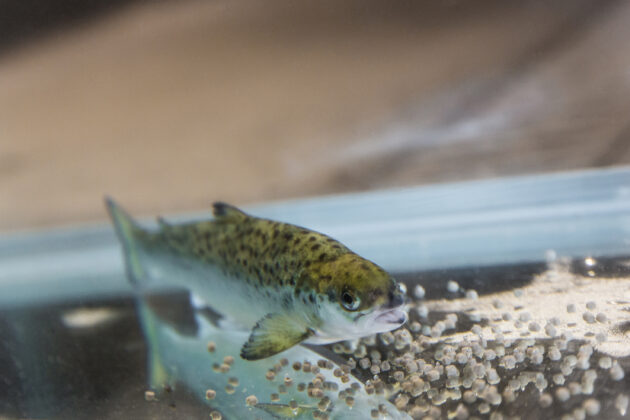
A new study from Nofima shows that salmon can be bred to use feed more efficiently. Calculations suggest that this could save the Norwegian salmon industry more than €100 million a year.
Main findings
- The research shows that salmon can be bred to use feed more efficiently by gaining less fat and more muscle. Much of the variation between salmon families is genetic, making these traits suitable targets for selective breeding.
- More feed-efficient salmon could bring substantial economic benefits. Calculations suggest that the industry could save around €105 million each year if the fat content of salmon were reduced from 21 to 18 per cent.
- The findings could benefit the entire value chain. Breeding companies could gain simpler tools for their breeding programmes, fish farmers could reduce feed use and emissions, and feed companies could develop more targeted feed formulations.
- Further trials involving larger fish are needed before the findings can be applied at full commercial scale.

This is among the most exciting work Nofima nutrition researcher Bjarne Hatlen has undertaken.
“That is because it could have such far-reaching consequences if the industry adopts it,” says Hatlen. “Feed is the largest cost in Norwegian salmon farming and accounts for most of its climate footprint.”
The research is about converting as much of the energy in feed as possible into muscle rather than fat.
“What happens is that fat is replaced by protein and water, making the fish less expensive to produce. Every gram of protein is accompanied by four grams of water at no additional cost, whereas fat merely replaces water and therefore does not add extra weight. There may also be positive side effects: leaner salmon may be healthier and of better quality,” says Hatlen.
Scientific method
- The dataset used by Hatlen and his colleagues is robust, although the trial involved only small fish.
- It comes from experiments with 70 groups of fish representing 35 salmon families from the Mowi Genetics breeding programme. All fish were individually tagged and genetically tested, and weighed 50 grams at the beginning of the experiment.
- The researchers kept the families in small tanks at Nofima’s research station in Sunndalsøra. Over seven weeks, they fed the fish and measured several outcomes: how much feed the fish ate, how much they grew, and how much energy and protein was retained in the fish or lost.
- Feed, fish and faeces were analysed in the laboratory for energy and protein, allowing the researchers to draw up an “account” of how energy and protein were distributed. They then combined the nutrition data with genetic data to identify traits that could be improved through selective breeding.
Key findings
The results show clear differences between salmon families in how efficiently they use feed, and that much of this variation is genetic. Traits such as growth, feed efficiency and the amount of fat deposited by the fish have moderate heritability. In other words, they can be improved through selective breeding.
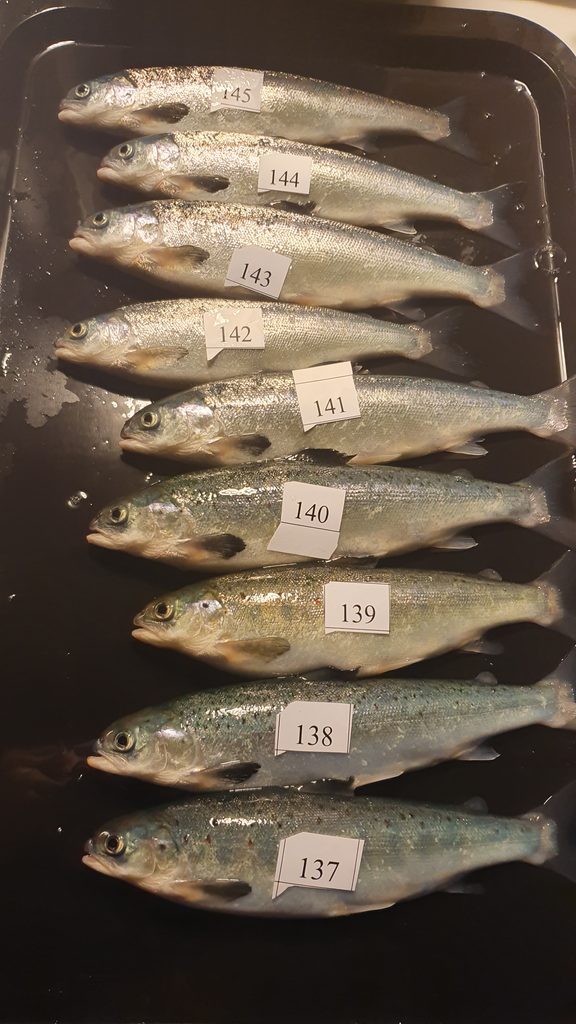
Salmon that grow quickly and deposit less fat for every kilogramme of growth use feed more efficiently.
In the experiment, about half of the energy and protein consumed was retained in the fish. The rest was lost as heat, faeces and nitrogen excretion. The researchers also show that if fish are genetically selected for lower body-fat levels without reducing growth, around half of the reduction in body energy could be realised as lower feed intake—in other words, improved feed efficiency.
Previous work at Nofima shows that harvest-ready Norwegian farmed salmon contain 21 per cent fat, which accounts for around two-thirds of all the energy in the fish.
“The proportion of fat can be reduced considerably, and this would lower the feed conversion ratio,” Hatlen believes.
Hatlen’s calculation of the potential economic saving considers a reduction in the fat content of whole fish. It is based on several assumptions: a feed price of around €1.38 per kilogramme, annual feed use of 1.5 million tonnes for salmon production, an initial feed conversion ratio of 1.05, and the assumption that 50 per cent of the energy saving in the fish can be translated into a better feed conversion ratio.
Based on these assumptions, the industry could save around €105 million annually by reducing the fat content of whole salmon from 21 to 18 per cent.
Could reduce farmers’ feed use
For breeding companies, the study opens possibilities for simpler measurements in breeding programmes. This could avoid costly and impractical measurements of feed intake in individual fish, provided that reliable methods are developed to measure fat in live fish. Matt Baranski, Genetics Manager in Mowi Genetics, comments:
“Selection for rapid growth over many generations has already brought substantial indirect improvements in feed efficiency. However, we have long been looking for practical ways to select more directly for this trait. That is why the results of this study are particularly exciting for us. They show that it may be possible to use simpler and more practical measurements as part of routine breeding work. This could not only reduce production costs, but also contribute to more sustainable use of the marine feed resources on which the aquaculture industry depends. This area has considerable potential, and we look forward to exploring how such methods can be applied in our breeding programmes”, says Baranski.

For salmon farmers, choosing particular genetic lines could mean lower feed use per kilogramme of fish produced, as well as lower emissions to the environment. For feed companies, the energy and protein accounts provide insight into where losses occur and how new feeds could be tailored to genetic lines that use feed more efficiently.
The idea behind the research is not new, but such trials are expensive and funding has taken time to secure. The work was carried out through the NewTechAqua project, funded by the EU’s Horizon 2020 programme, and involved breeding and nutrition researchers from Nofima, the Norwegian University of Life Sciences (NMBU) and Mowi Genetics.
Trials with larger fish needed
What is new about this research is that it quantifies the effects of breeding leaner salmon. However, the researchers underline that the study was conducted with small fish in freshwater under controlled conditions.
Further research is needed in larger fish at sea, along with the development of practical methods for measuring body fat in live breeding candidates, before the potential can be fully realised at commercial scale.
Facts about the research
The project
Publication
Contacts


Research facilities