
PathoScript
Decoding host-pathogen interactions at the skin interface for developing efficient delousing strategy in Atlantic salmon
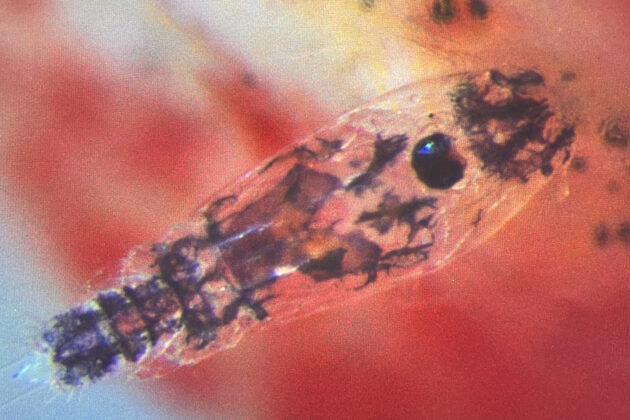
PathoScript aims to uncover the biological and molecular mechanisms behind the attachment of sea lice to salmon, and to explore new ways to prevent it.
Start
01. Jan 2026
End
31. Dec 2029
Funded by
Research Council of Norway
Cooperation
Matre Research Station (IMR), Roslin Institute, SINTEF
Project Manager(s):
Other Participants:
Aleksei Krasnov
Christian Renè Karlsen
Elisabeth Ytteborg
Torstein Tengs
Tone-Kari K. Østbye
Background
Salmon lice (L. salmonis) is a major concern in salmon farming. Their infestation can lead to skin damage, secondary infections, poor growth and mortality, making them a major fish welfare and economic concern. Despite decades of research and numerous control measures, current treatments have not provided lasting solutions, as lice rapidly develop resistance to delousing methods. Moreover, no preventive strategy currently exists that effectively protects fish health while ensuring sustainable production. Thus, it is crucial to develop innovative, long-term targeted strategies.
Objectives
Although, several initiatives have focused on understanding the salmon lice life cycle and its interaction with the host, one fundamental question remains unresolved: How does salmon lice larvae utilize their frontal filament to securely attach to the Atlantic salmon skin without triggering a localized inflammatory response? PathoScript addresses this knowledge gap by shifting the focus from the host to the parasite.
What we do
The early larval stage of the lice forms a specialized structures to anchor itself to the salmon. Yet, the biological and molecular mechanisms behind this process remain largely unknown.
This project aims to fill critical knowledge gaps by uncovering the hidden mechanisms that allow larvae to attach so effectively and almost without being detected by the host. By revealing the key molecular “conversations” between the parasite and the host at the point of contact, the project seeks to uncover novel biological vulnerabilities that could be targeted to prevent attachment and ultimately improve salmon health and welfare.
While addressing these questions presents a high-risk challenge, the project also has the potential to deliver groundbreaking solutions leading to the development of non-invasive, precision-targeted treatment that ensures fish health.
The project will use advanced molecular tools such as spatial transcriptomics and high-resolution proteomics to study the interaction between lice and salmon skin at the precise site of contact. By identifying the key genes, proteins, and structural components involved, the project will build new knowledge about how they attach and how it might be disrupted. Further, the project will test safe and sustainable approaches to interfere with attachment, including gene-silencing and targeted delivery systems that could weaken the parasite’s ability to adhere without harming the fish. Through collaboration between leading experts in Atlantic salmon skin health, immunology, bioinformatics, vaccine development, and drug delivery, PathoScript ensures a robust and innovative approach to tackling the salmon lice problem.
The project will contribute to developing next-generation, non-invasive treatments against salmon lice and aims to improve fish welfare, reduce chemical use, and support a more sustainable way of salmon farming. The results may also provide insights applicable to other species affected by external parasites.
Contact

Research areas
Farmed fish
Files and Links
About the project at website of the Research Council of Norway