
People who track their food waste generate significantly less waste
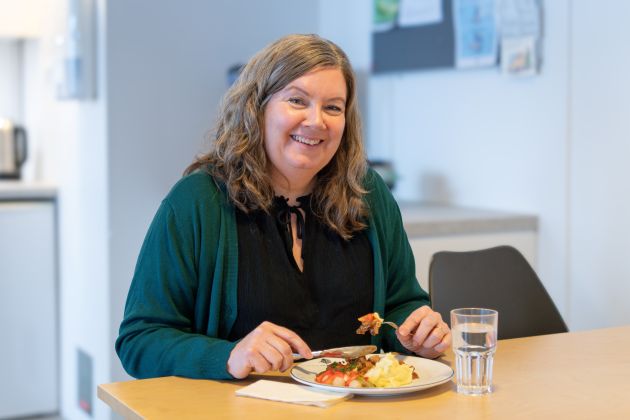
Everyday actions to reduce food waste deliver strong short-term impact. Over the longer term, simply becoming aware of one’s own waste may be just as important as specific advice and interventions. This is the main finding from Nofima scientist Kristine Myhrer Svartebekk’s PhD on food waste in Norwegian households with children.
In brief
- Families with children reduced dinner food waste by 39% over four weeks by focusing on using leftovers.
- After one year, the control group had also reduced its waste, and the difference between groups had effectively disappeared. Both groups achieved a 29% reduction, likely because measuring waste increases awareness and drives self-directed action.
- The project identified three distinct consumer profiles based on environmental awareness and personality traits. These profiles differed significantly in both waste levels and response to interventions.
Svartebekk followed 230 randomly selected households with children over seven weeks. Half received specific advice and tasks aimed at reducing leftover dinner waste. The other half simply recorded what they discarded, without receiving any guidance.
“What surprised us was that the families who only measured their food waste gradually reduced it just as much as those who received concrete advice in addition. We believe that measurement itself increased awareness of habits and enabled households to develop their own tailored strategies over time,” she explains.
Leftovers on the menu cut waste by 39%
The intervention group, families who both tracked waste and received guidance on repurposing leftovers into new meals, reduced food waste by 39% in the short term (seven weeks).
The control group, which only measured waste, reduced it by 22% over the same period.
Awareness delivers lasting impact
“The most interesting result came after one year. At that point, the difference between the groups had disappeared. Combined, both had reduced dinner food waste by 29%. This suggests that simply measuring waste makes people aware of how much they discard, leading to reductions comparable to structured interventions,” says Svartebekk.
Her interpretation is that top-down interventions deliver rapid results, but their impact fades once guidance stops. In contrast, awareness builds intrinsic motivation, allowing each household to adopt measures that fit their routines.
“Changing habits takes time, longer than the intervention period. Regular follow-ups might have further strengthened the long-term impact. That is something worth exploring in future studies,” she adds.
One solution does not fit all

IConsumers respond differently to food waste interventions. The scientists identified three profiles based on environmental awareness and personality traits:
- “Need to Change”: High waste, low concern. This group has the greatest potential and showed the largest measurable reduction (38%) when engaged.
- “Want to Change”: Already motivated and environmentally aware, with relatively low waste levels and limited room for further reduction.
- “Hard to Change”: Routine-oriented and resistant to change, making them difficult to recruit and influence.
“Personality traits and environmental awareness shape both how much we waste and how we respond to interventions. The greatest societal impact comes from targeted measures—particularly towards the ‘Need to Change’ group, which combines high waste levels with low intrinsic motivation,” says Svartebekk.
Supporting national food waste targets
Norway aims to halve food waste by 2030. Households account for nearly half of total food waste, with families with children among the largest contributors, particularly meal leftovers.
Svartebekk believes the target is achievable but requires more targeted approaches. One key measure is focusing efforts on high-impact groups such as “Need to Change”. At the same time, the study shows that awareness is critical across all profiles. Campaigns and dedicated “measurement weeks”, where consumers track their own waste, can strengthen motivation and drive behaviour change.
“I have always tried to keep my own food waste as low as possible, but it is not always easy. I aim to improve continuously and encourage small changes in those around me. A simple tip is to check the fridge before shopping and before cooking, and to use leftovers and ingredients nearing their use-by date. Most meals benefit from a few extra vegetables or a splash of dairy, it rarely makes the dish worse,” she says.
Scientific method
- Randomised controlled trial (RCT), the gold standard for establishing causal relationships. Participants were randomly assigned to either an intervention or control group, reducing bias and enabling robust comparison.
- Participants: 230 Norwegian households with children; 144 in the one-year follow-up. Findings primarily apply to this demographic.
- Duration: 52 weeks. This extended follow-up is uncommon in consumer food waste research and provides rare insight into long-term effects.
- Intervention group: Converted leftovers into new dinner meals over four weeks, supported by digital learning resources and continuous waste measurement.
- Control group: Measured food waste only, without receiving any form of instruction.
About the research
he PhD thesis is titled “From waste to awareness: designing household food waste interventions across consumer profiles”.
The work was conducted at Nofima in Ås from September 2021 to December 2025, supervised by Dr Valerie L. Almli (Nofima/NMBU), with co-supervisors Dr Mari Ø. Gaarder (Nofima) and Professor Siv K. Bøhn (NMBU).
The research is part of the Research Council-funded project Sustainable Eaters, led by Nofima in collaboration with 26 partners from research, industry, the public sector, and NGOs.
Experimental work was partly supported by the Fund for Research Levy on Agricultural Products (FFL) through the projects Food for Future and InnoSense.

Contact

Research areas
Consumer insight
Topics
Food waste