
TorskRAS
Development of Production Protocol for Atlantic Cod in RAS
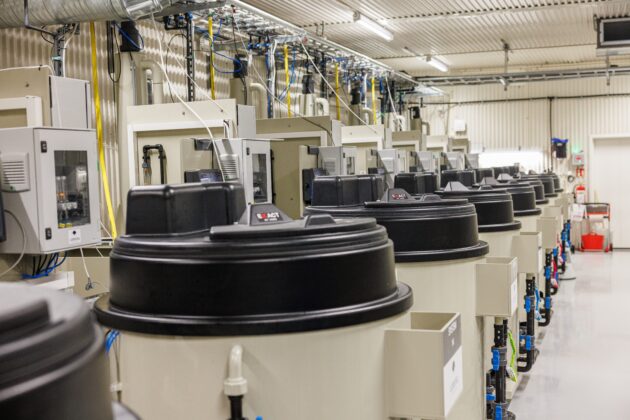
RAS (Recirculating Aquaculture Systems) has emerged as a potential system for cod juvenile production in Norway. This project aims to build competence for the cod research in RAS at Nofima.
Start
01. Jan 2025
End
31. Dec 2025
Funded by
Nofima
Project Manager(s):
Other Participants:
The objective of this project is to develop production protocol for Atlantic cod, Gadus morhua juveniles in RAS in comparison to low or high-water exchange rate (LWE vs HWE).
This production protocols will also support the Norwegian National Cod Breeding Program at Nofima, Tromsø for production of high-quality juveniles.
Objectives
The main objectives of the project are:
- Identification of requirements and potential bottlenecks for cod juvenile production in RAS.
- Hands-on-experience during testing and developing a production protocol. Comparison of cod juvenile performance in low or high-water exchange rate.
- To study on growth performance, deformities, welafre scoring and water quality parameters in relation tolow or high-water exchange rate in RAS.
- Evaluation and summary of procedures, results and key learnings, providing inputs for a strategic plan on cod research at Nofima, together with the Norwegian National Cod Breeding Program.
This is what we do
Cod fingerlings (25-30g) were procured from Ode, Ålesund in November 2024 and fish are maintained in the flow-through tanks in until January 2025. After that the fish is transferred to Single RAS facility for experiment. Low (500 L/kg feed/day) or high (1000 L/kg feed/day) water exchange rate (LWE vs HWE) is evaluated in SingleRAS (500 Litre) tanks in three replications for cod juveniles over a 7-week experimental period.
Each tank is stocked with 75 cod (∼130 g) and water quality parameters such as temperature (12 ℃), pH (7.9), oxygen (> 90% saturation), CO2 (< 6 mg/L), salinity (32 ‰), total ammonia nitrogen (< 1 mg/L) and nitrite (< 0.5 mg/L) is maintained in this limit range.
Growth performance, deformities (X-ray) and welfare indicators of cod juveniles is recorded and compared between high and low water exchange rate. Water quality is monitored and recorded during the trial.
Results of the project are shared in an article at Landbased AQ. In Norwegian only (so far).
Contact

Research facilities
Research Station for Aquaculture – Sunndalsøra
Similar projects
Breeding programme for cod
Files and Links