
High yields and adequate baking quality lay a solid foundation for Norwegian bread wheat
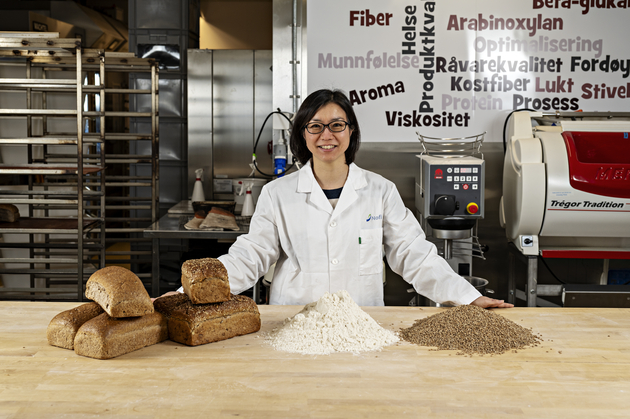
The breadmaking quality forecast shows how this season's wheat performs in baking. Mills, grain traders and authorities can use it to plan the use of Norwegian bread wheat and to decide which qualities need to be imported. Some areas were affected by poor overwintering and drought during the growing season, but the weather at harvest was favourable in many places, resulting in high yields.
In brief
- Favourable weather during harvest ensured that this season’s bread wheat was mostly free from pre-harvest sprouting (high enzyme activity). Some samples, however, had too little enzyme activity (a high falling number), but the industry can take steps to address this.
- Protein content was adequate in both spring and winter wheat, although spring wheat had slightly lower protein levels compared to last season.
- Baking quality was largely as expected for each class, but spring wheat was somewhat weaker than last season, especially in class 3..
NoThe November forecast from the market regulator points to an abundant supply of Norwegian bread wheat. In theory, Norwegian bread wheat could meet 80% of demand, but because the available qualities do not fully match the industry’s needs, the Norwegian share is likely to be around 68%.
“This shows that the industry as a whole is moving in the right direction towards our goal of a 90% Norwegian share. To reach this target, it is essential for the industry to work collaboratively to identify how the supply of and demand for bread wheat quality can be better matched,” says researcher Shiori Koga from Nofima.
The quality forecast helps the industry with decision-making
Each autumn, Nofima, NIBIO, and NMBU assess the breadmaking quality of Norwegian bread wheat and write a report. The mills also analyse samples, and their results are incorporated into the quality forecast. The forecast helps mills and bakeries plan how to make the best use of Norwegian wheat and determine which quality characteristics may need to be imported.
The report is based on analyses of 54 samples from grain receptions and 116 samples of key market varieties from field trials. There were few class 1 samples, reflecting reduced production of the cultivar Mirakel. Sample numbers in the other classes were adequate, making forecasts for those classes more reliable.
“The early quality assessment gives us an overview of breadmaking quality and allows us to pick up changes from the previous season, so that the industry can plan and implement measures in a timely manner,” says Shiori Koga.
Gluten quality is important for breadmaking quality
Gluten is storage proteins that give dough its viscoelastic properties. Gluten quality mainly affects the shape of the bread, but also its size and firmness to some degree. Mills need bread wheat with varying gluten qualities to produce different types of flour with stable quality both within and across seasons.
“We see variation in protein content and gluten quality within the same class. The industry should monitor this throughout the season,” says Koga.
The breadmaking quality of the classes is as expected:
- Classes 1 and 2 have strong gluten. The dough therefore tolerates intensive kneading, and the gluten network holds the gas bubbles well during proofing and baking. This gives hearth bread with a rounder shape. Analyses showed that class 2 was somewhat weaker and exhibited greater variation among samples from different locations.
- Class 3 is the weakest bread wheat class and produces flatter bread. This season, class 3 was weaker than in previous seasons. This may be due to the increased proportion of the variety Festus, which is weaker than earlier class 3 varieties such as Zebra and Krabat. Environmental conditions during grain filling may also have affected quality.
- Class 4 is the winter wheat class and has stronger gluten than class 3, but the mills’ results show somewhat weaker gluten than last season.
A large share of class 2 is holding back a high Norwegian share
This year, we have a surplus of class 2 wheat, predominantly from Betong, one of the strongest wheat varieties in Norway. The variety makes class 2 as strong as class 1. The high production volume of Betong is the primary reason the Norwegian share will be lower than it otherwise could have been.
“The baking quality in class 2 was somewhat weaker than in previous seasons, so it might be possible for the mills to use a little more class 2 in some of their flour blends. However, this is something the mills need to evaluate against the quality requirements for each type of flour blend,” says Shiori Koga.
High falling number requires attention
The falling number indicates the level of enzyme activity in flour, particularly amylase activity. Amylase breaks down starch into sugars, which yeast uses as a nutrient and converts into gas, causing the dough to rise. A high falling number indicates low amylase activity, resulting in a slower baking process.
Falling numbers in this season’s samples were generally high, and some were very high. Grain traders and mills should pay particular attention to batches whose falling number is too high to be corrected. Good communication between mills and bakeries is also important. If the falling number is too high, mills or bakeries can add malt or amylase.
“Unlike a low falling number, a high falling number can be managed. By implementing appropriate measures, we can make effective use of high-quality Norwegian wheat,” says Koga.
Scientific method
The researchers used these methods for quality assessment:
- Falling number to measure enzyme activity in the flour.
- Farinograph to measure water absorption and mixing properties.
- Extensograph to measure the viscoelastic properties (resistance to extension and extensibility) of the dough.
- Baking tests with white and wholemeal bread (50% wholemeal flour) to measure volume, shape and crumb firmness.
The researchers also conducted an extension test on washed gluten from the variety samples derived from the field trials.
Research Facts
The project Quality forecast for Norwegian bread wheat is funded by the grain marketing levy (omsetningsavgift på korn) and the Research Funds for Agriculture and the Food Industry (FFL/JA) through the Gene2Bread project. The client is Felleskjøpet Agri market regulator.
Report: Research report 44/2026, published 6 November 2026, by Shiori Koga (Nofima) and Anne Kjersti Uhlen (NMBU).
The collaboration partners are Nofima, NIBIO and NMBU, together with Fiskå Mølle, Felleskjøpet Agri, Strand Unikorn, Norgesmøllene and Lantmännen Cerealia. The variety samples come from field trials conducted by NIBIO and the Norwegian Agricultural Extension Service (NLR).
Contact

Research areas
Raw material knowledge
Topics
Cereals
Research facilities