
LiceSAIGE
Deciphering genetic effects of lice resistance in Atlantic salmon
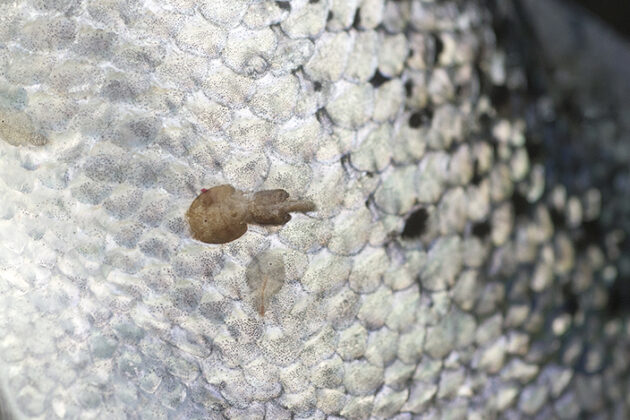
This project is about deciphering direct (host x parasite) and indirect (host x host) genetic effects of lice resistance in Atlantic salmon.
Start
01. Jun 2026
End
31. May 2029
Funded by
Norwegian Seafood Reserach Fund (FHF)
Cooperation
MOWI Genetics AS (key personell: Dr. Solomon Antwi Boison and Dr. Panya Sae-Lim), BR Gjerde/Mowi (Dr. Bjarne Gjerde), The Roslin Institute (Prof. Andrea Doeschl-Wilson), Wageningen University (Prof. Piter Bijma), AquaGen AS (Dr. Jørgen Ødegård), Benchmark Genetics Norway AS (Dr. Eric Ignatz and Dr. Serap Gonen)
Project Manager(s):
Other Participants:
Sea lice is one of the biggest challenges facing the Norwegian salmon industry, causing major economic losses, welfare concerns, and environmental impacts. Current control methods rely heavily on repeated treatments, which are costly and can stress the fish.
This project investigates how genetic factors can be used more effectively to improve resistance to sea lice in Atlantic salmon. In particular, it focuses on both direct genetic effects (how resistant an individual fish is) and indirect genetic effects (how fish influence lice infection in other fish in the same group).
Using large-scale experimental studies and advanced statistical models, the project will quantify these genetic effects and determine how they interact. The results will be used to develop improved breeding strategies that enhance resistance not only at the individual level, but across entire fish populations.
Background
Control of sea lice in Atlantic salmon through selective breeding has revealed clear differences in lice load between resistant and susceptible fish when challenged communally; however, measurable genetic gains have remained limited or absent when these groups are evaluated separately. This discrepancy has led to the main hypothesis that interactions among fish, together with the combined effects of direct and indirect genetic influences, play a key role in shaping lice infestation levels. These effects are not currently accounted for in existing breeding strategies, potentially limiting their effectiveness. There is therefore a need for new knowledge and improved models to better understand and exploit genetic resistance to sea lice.
Objectives
LiceSAIGE project aims to unravelling the present lack of genetic gain in resistance to the salmon lice in Atlantic salmon through estimates of reliable (co)variances estimates of the direct and indirect genetic effects for sessile lice counts.
We will achieve this main goal through following specific targets:
– Obtain a reliable estimate of the magnitude of the tank effect for sessile lice count.
– Obtain reliable estimates of genetic (co)variances of direct and indirect genetic effects for sessile lice count.
– Obtain a reliable estimate of the genetic correlation between the sessile lice count of salmon challenge tested in a common tank and of their sibs challenge tested in a social interaction experiment.
– Obtain by stochastic simulation estimates of the expected genetic gain for reduced lice susceptibility when applying selection for both direct genetic effect (DGE) and indirect genetic effect (IGE) for sessile lice count.
What we do
In LiceSAIGE, the underlying causes of the limited or missing genetic gain in resistance to sea lice will be investigated through targeted experimental designs that capture both individual performance and interactions among fish. These knowledge gaps will be addressed through large-scale intensive challenge experiments and advanced analytical approaches aimed at disentangling direct and indirect genetic effects and their contributions to lice infestation dynamics.
The project will generate new knowledge by developing improved protocols for lice challenge testing and by estimating robust genetic parameters for both direct and indirect genetic effects. These efforts will provide a stronger scientific basis for evaluating host resistance and parasite transmission under realistic farming conditions.
Finally, the results will be integrated to potentially develop improved breeding strategies and predictive tools that incorporate both individual- and group-level genetic effects. Close collaboration with breeding companies will ensure that the outcomes are directly applicable, enabling more effective and sustainable genetic solutions for sea lice control in commercial salmon production.
Contact

Research areas
Breeding and genetics
Research facilities
Research Station for Aquaculture – Sunndalsøra
Files and Links