
The raw ingredient type shapes how consumers perceive sustainability in food
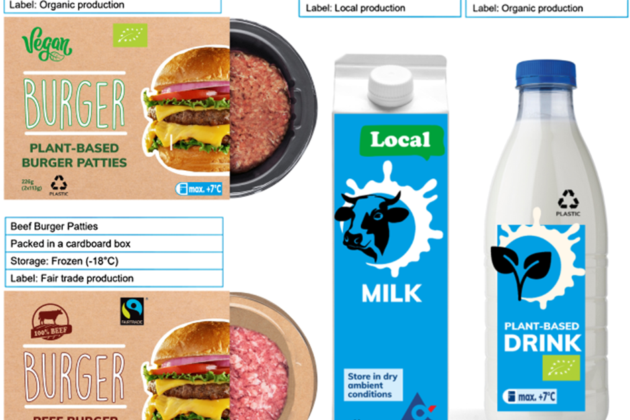
Scientists have investigated which properties of food products influence how consumers assess sustainability. The results differ between product types.
Main findings
Perceptions of sustainability in food among Swedish and Italian consumers:
- Raw ingredients are most important, particularly for burgers, where plant-based is regarded as the most sustainable
- Carton packaging is perceived as more sustainable than recycled plastic, especially for milk
- Labels provide reassurance, and “local” is perceived as the most sustainable
- Shelf life and storage methods are perceived as the least important factors when evaluating a product’s sustainability
Participants evaluated products based on four properties: raw ingredient, packaging, certified label and shelf life for meat burgers, milk and corresponding plant-based substitutes.
“Our study shows that the choice of raw ingredient is a more important sustainability factor for burgers than for drinks. However, regardless of product category, it is the raw ingredient type, i.e., whether it is of animal or plant origin, that weighs the most when people decide how sustainable a food is,” says senior scientist Valérie Almli at Nofima.
She adds an interesting finding: “For burgers, participants considered the plant-based variant to be the most sustainable, whereas there was a slight tendency for (animal-based) milk to be regarded as more sustainable than plant-based milk alternatives.”
The choice of raw ingredient type accounts for 37 percent of the total sustainability assessment for burgers. The corresponding figure for milk and milk substitutes is 25 percent, clearly lower.
600 consumers assessed the importance of different properties
The Nofima scientist, together with scientists from Estonia, Germany and Denmark, has examined how 600 consumers in Sweden and Italy assess what constitutes sustainable food.

Participants were presented with different variants of either burgers or drinks and asked to choose the option they considered most sustainable.
They assessed the following four key properties:
- Raw ingredient (animal or plant-based origin)
- Packaging material (carton or recycled plastic)
- Certified label (local, organic or fair-trade)
- Shelf life (long shelf life: frozen for burgers / ambient temperature for drinks, or short shelf life: chilled, for both products)
Carton perceived as more sustainable than recycled plastic
Carton packaging was perceived as more sustainable than recycled plastic, and the importance of packaging was considered greater for milk and milk alternatives than for burgers.
For drinks, the packaging material was almost as important as the raw ingredient type, with only one percentage point difference and a weighted importance of 24 percent. For burgers, participants assigned packaging material an importance of 13 percent.
“It is interesting that carton scores so highly. This shows that many associate fibre-based packaging with responsible choices,” says Valérie Almli.
Labels and credibility
Certified labels such as local, organic and Fairtrade carried the same weight for burgers as for milk and milk alternatives. Labels accounted for 22 percent of the total importance for sustainability across both product categories.
Certified labels provide reassurance and help people make more informed choices, which has substantial impact when it comes to sustainability in food. Among the three options – local, organic and Fairtrade – consumers perceived local as sustainable.
Shelf life and storage: the forgotten factor
Storage conditions for shorter or longer shelf life – chilled, frozen or ambient – were the least used of the four factors in sustainability assessments, with a weight of 13 percent. This is notable, since shelf life and storage methods affect both energy use and food waste.
There were differences in how participants assessed the sustainability of the various alternatives. For milk and milk alternatives, both Swedish and Italian consumers perceived long shelf life at ambient temperature (ultra‑high‑temperature processed products) as more sustainable.
For burgers, Italian participants more often judged chilled burgers to be sustainable, while Swedish participants did not have a clear view of how storage conditions influence sustainability.
Facts about the research
You can read more about the research in the scientific publication:
The research was funded by the European Sensory Network through the Sustainability Dimensions Research Project, by the Norwegian levy on agricultural products (FFL) through the strategic programme FoodForFuture, and by the Research Council of Norway through the project Sustainable Eaters.
